A theory of colour and consciousness
The blueness of blue is not a property of light.
It is the memory of the sky made internal.
The hypothesis
Every colour's felt quality — its mood, temperature, emotional resonance — emerges not from wavelengths but from learned neural associations. Blue feels calm and distant because it co-occurs with sky and water. Red feels urgent because it co-occurs with fire and blood. Qualia are not ineffable primitives. They are the world remembered.
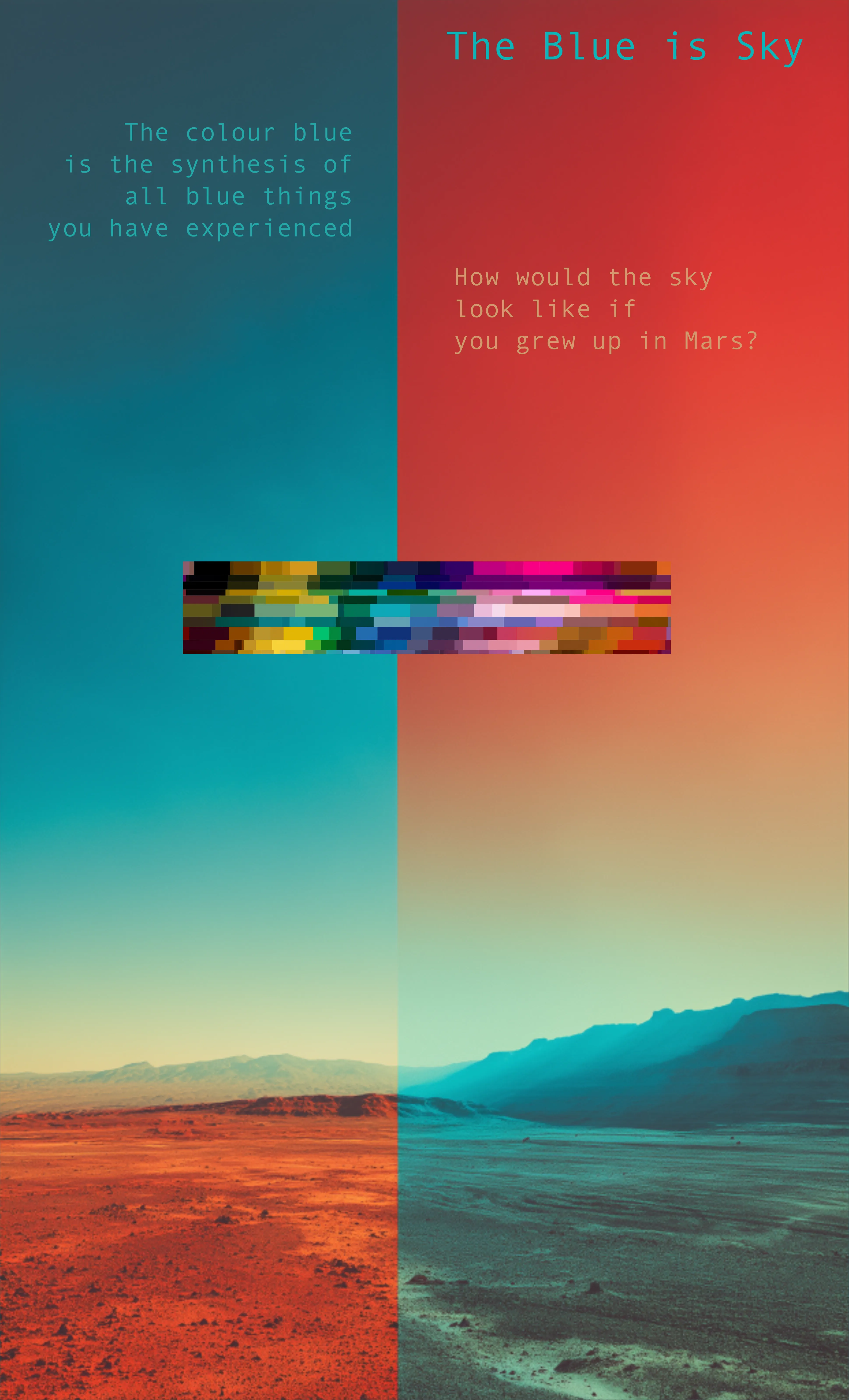
This is the core reversal. We usually say colours have emotional associations. The theory says: those associations are what colours are. The feeling does not accompany blue — it is blue. Change the ecology, change the colour's feel. A Martian child raised under a red sky would experience that sky's hue as their world's version of blue: open, calm, infinite.
The theory extends beyond colour. All qualitative experience — the texture of a sound, the weight of a feeling — may be understood as learned associative syntheses. Consciousness is ecological memory made immediate: the world's pattern of relations realised within a living system.
The colours
Blue
The sky made internal.
Red
Fire and blood, made visible.
Gold
Value solidified into light.
Black
The weight of all absence.
White
All colours held in suspension.
Green
Life as a colour.
Yellow
The colour closest to light itself.
Orange
The colour of endings that are also beginnings.
Purple
The rarest colour in nature, and the costliest to make.
Pink
The colour of what is alive and newly arrived.
Grey
The world without commitment to a feeling.
Brown
The colour of the ground beneath everything.
Cyan
Blue distilled to its coolest, most crystalline form.
Magenta
A colour that does not exist in the spectrum — only in the mind.
Neon
A colour that shouldn't exist, screaming to be seen.
Silver
The colour that gives back what it receives.
Indigo
Blue pressed into darkness until it becomes something else.
Turquoise
The colour of water over paradise.
Crimson
Red with nowhere left to go but deeper.
Ochre
The first colour humanity ever made its own.
The lab
The lab is a generative interface: ask a question about a colour, a feeling, a memory. The response comes as text and as image — poetic, scientific, or simply illustrative. What is neon? What does ochre remember? What would blue feel like on Mars?
Enter the lab
