← Theory

The Mars
Experiment

A child is born on Mars. The sky is red.
What colour does she see when she looks up?

Imagine a child born and raised on Mars. The sky there is red — tinted by iron dust — yet to her eyes it would not feel red.

She would not feel heat or urgency when looking up, because those emotions have never accompanied that wavelength. Fire is not common on Mars. Blood is not part of her daily experience against that sky. Instead, everything her world offers — its distances, horizons, the thin atmosphere — is composed of that same long-wave light.

The Martian sky would become her sign of openness and calm. Its colour would feel the way blue feels to us.

For her, the colour that carries the quality of sky — open, distant, infinite — would be the colour of that sky. Though its spectrum would be red to us, it would be her blue. Blue is not a wavelength. Blue is what sky looks like. And she is looking at sky.

This is what 'The Blue Is Sky' means. Blue is not a property of light — it is the property of sky itself.

It reverses the ordinary phrase: the sky is not blue — blue is sky. Blue is the way any sky appears in experience, whatever its spectrum. It is the qualia of sky-ness: the openness, the distance, the calm that a canopy of light composes. On Mars, under a red-wave sky, the child looks up and sees blue, because blue is what sky looks like.
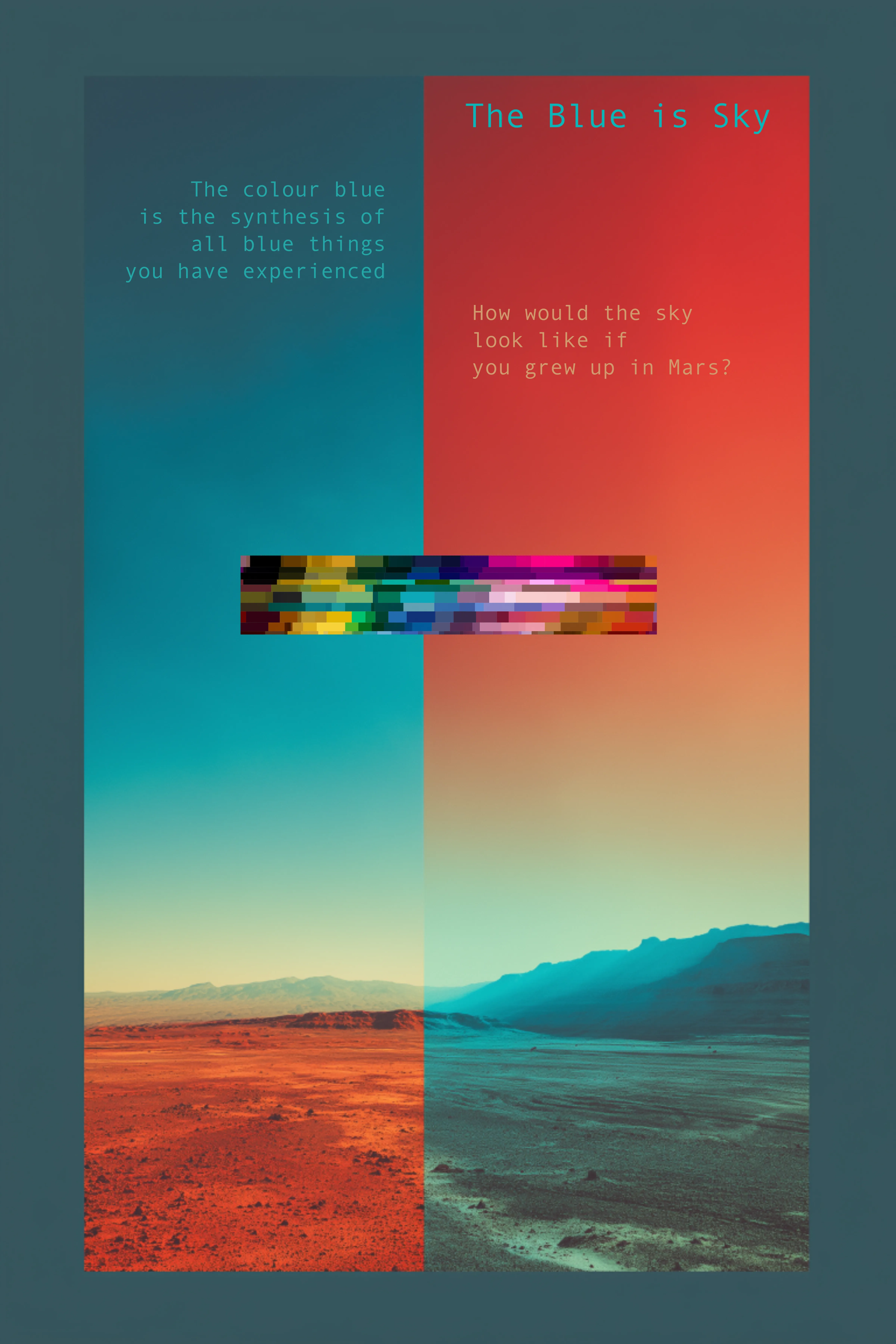
It helps to start simple. Suppose the sky were the only red thing. Then the long-wave band would compose that mode of appearance entirely: red-wave light becomes the blueness of the world.

If we later add fire, blood, and dust, those new co-occurrences would blend their feelings and appearances into a new colour. The same band would no longer seem the same — the synthesis shifts as the ecology accumulates. But the basic point stands: colours are not fixed properties of light but ecological compositions of a world.

A sky is not an object but a background reflectance — an almost-white field that floods every perception. Because it is everywhere, it weighs heavily in the synthesis.

Change that field, and you change how light itself feels. The Martian sky would build another palette of experience, another emotional physics. Its children would live inside it, just as we live inside ours. A different sky makes a different consciousness — not metaphorically, but constitutively.

The conceptual test

The Mars experiment functions as a conceptual falsification test. If qualia were fixed physical properties, their appearance would not change with ecological structure. But if they are learned associations, then altering the world's regularities should produce a corresponding shift in feeling. The Martian child's calm red sky supports this second view: the texture of experience follows environmental roles, not wavelengths.

This principle generalises. The same associative dependence holds for sounds, textures, emotions. Each arises from the synthesis of repeated co-occurrences.

The Martian sky demonstrates, in counterfactual form, that to change the world's structure is to change the form of consciousness itself. Qualia are ecological. They are not inside us or outside in the world — they are the relationship between them, learned and compressed into the fabric of experience.

← Full theory / Blue →